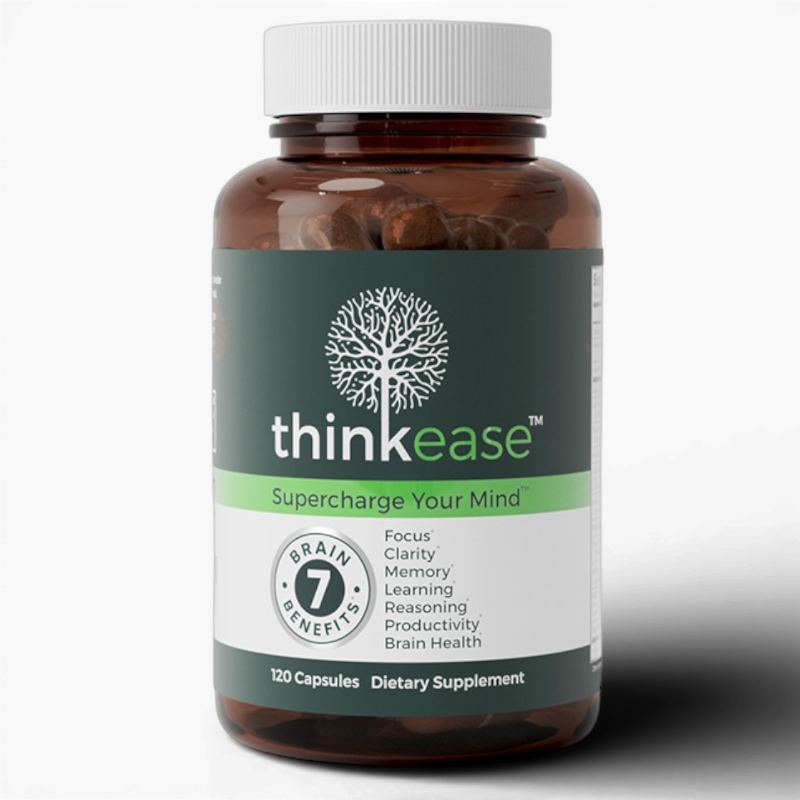
ThinkEase is a caffeine-free daily nootropic made by Health Nutrition, the company behind Testogen and PhenGold. Its four-capsule serving combines 16 ingredients for memory, focus and mental energy, including bacopa, citicoline, L-theanine, rhodiola, phosphatidylserine and saffron, with every dose printed on the label.
It is also our highest rated nootropic. Because that is a strong claim, this review sets out exactly what is in it, where the evidence is strongest, where the doses are lighter, and what results are realistic.
Quick verdict
ThinkEase is the most complete fully disclosed, caffeine-free nootropic we have reviewed. Six of its key ingredients are at the doses used in human research: 300 mg of bacopa at 50% bacosides, 250 mg of citicoline, 200 mg each of L-theanine and rhodiola, 100 mg of phosphatidylserine and 30 mg of saffron. A few supporting ingredients are lighter, and its memory benefits build over weeks rather than hours. You can learn more at thinkease.com.
ThinkEase pros and cons
What we like about ThinkEase
- 16 ingredients, every dose disclosed, no proprietary blends
- Bacopa, citicoline, L-theanine, rhodiola, phosphatidylserine and saffron at research doses
- Caffeine-free, so it suits any time of day and stacks with your own coffee
- 100-day money-back guarantee
Where ThinkEase falls short
- Four capsules a day
- Acetyl-L-carnitine (750 mg) and lion's mane (550 mg) are about half the amounts studied
- Bacopa's memory benefits take eight to twelve weeks to build
- No caffeine, so add your own coffee if you want an immediate lift
ThinkEase at a glance
| Made by | Health Nutrition |
|---|---|
| Daily serving | 4 capsules a day |
| Stimulants | Caffeine-free |
| Key ingredients | Bacopa 300 mg (50% bacosides), citicoline 250 mg, L-theanine 200 mg, phosphatidylserine 100 mg, plus 12 more |
| Label | Every dose disclosed, no blends |
| Price | $74.99 for 30 days (from $44.99 a bottle on the five-month pack) |
| Cost per day | $2.50 |
| Guarantee | 100-day money-back guarantee |
| Hyperguides score | 9.5/10 |
What is ThinkEase?
ThinkEase is sold by Health Nutrition. Each four-capsule serving contains acetyl-L-carnitine (750 mg), lion's mane (550 mg), bacopa (300 mg at 50% bacosides), N-acetyl L-tyrosine (275 mg), citicoline (250 mg), L-theanine (200 mg), rhodiola (200 mg), phosphatidylserine (100 mg), pine bark extract (75 mg), saffron (30 mg), PQQ (10 mg), lutein (10 mg), zeaxanthin (2 mg) and three B vitamins: B6, folate and B12.
The formula covers three jobs. Bacopa, citicoline, phosphatidylserine and lutein support memory and learning over time. L-theanine, rhodiola and tyrosine support calm focus and resistance to mental fatigue. Saffron supports mood and stress, which affect concentration more than most people realize.
ThinkEase ingredients and doses
We grade our own picks with the same scale as every other product. The table compares each dose with the research.
| Ingredient | Per daily serving | What research used | Our read |
|---|---|---|---|
| Acetyl-L-carnitine (acetyl-L-carnitine HCl) | 750 mg | 1.5 to 3 g a day in older adults | Moderate dose |
| Lion's mane (fruiting body) | 550 mg | 1 to 3 g a day of mushroom | Moderate dose |
| Bacopa monnieri (50% bacosides) | 300 mg | 300 mg a day of extract standardized to about 50% bacosides (about 150 mg of bacosides) | Research dose |
| N-acetyl L-tyrosine | 275 mg | About 2 g of tyrosine under stress | Low dose |
| Citicoline | 250 mg | 250 to 500 mg a day | Research dose |
| L-theanine | 200 mg | 100 to 400 mg, most often 200 mg | Research dose |
| Rhodiola rosea (3% rosavins, 1% salidroside) | 200 mg | 170 to 600 mg a day of standardized extract | Research dose |
| Phosphatidylserine (from sunflower lecithin) | 100 mg | 100 to 300 mg a day | Research dose |
| Pine bark extract (95% proanthocyanidins) | 75 mg | 100 to 150 mg a day | Moderate dose |
| Saffron extract (0.3% safranal) | 30 mg | 28 to 30 mg a day | Research dose |
| PQQ | 10 mg | 20 mg a day | Moderate dose |
| Lutein | 10 mg | 10 to 20 mg a day with zeaxanthin | Research dose |
| Zeaxanthin | 2 mg | About 2 mg a day with lutein | Research dose |
| Vitamin B6 (as P-5-P) | 2.5 mg | Daily need 1.7 mg; upper limit 12 mg | 147% of daily need |
| Folate (as L-5-methylfolate) | 167 mcg DFE | Daily need 400 mcg DFE | 42% of daily need |
| Vitamin B12 (as methylcobalamin) | 7.5 mcg | Daily need 2.4 mcg | 312% of daily need |
Acetyl-L-carnitine (750 mg)
Acetyl-L-carnitine's cognitive evidence comes mostly from older adults with mild cognitive impairment: a meta-analysis of 21 trials using 1.5 to 3 g a day found benefits over placebo. Evidence in healthy younger adults is thin, so smaller doses are best seen as support for mental energy rather than a memory treatment.
At 750 mg, the dose is respectable but short of the 1.5 to 3 g a day in older adults used in studies.
Lion's mane (550 mg)
Human trials have used 1 to 3 g a day of the whole mushroom, with the clearest results in older adults with mild cognitive impairment. Fruiting body products are generally preferred over mycelium grown on grain, because the fruiting body holds more of the compounds that were studied.
ThinkEase includes 550 mg. That is a reasonable amount, though below the 1 to 3 g a day of mushroom that most trials used.
Bacopa monnieri (300 mg)
The research dose is 300 mg a day of an extract with roughly 40 to 55% bacosides, taken for at least 12 weeks. At that level, trials show modest gains in memory and processing speed, though not every study finds an effect. Taking it with food reduces the mild stomach upset some people notice.
ThinkEase's 300 mg sits within the 300 mg a day of extract standardized to about 50% bacosides (about 150 mg of bacosides) used in the trials. Standardized to 50% bacosides, it delivers about 150 mg of bacosides against roughly 150 mg in the main trials.
N-acetyl L-tyrosine (275 mg)
Tyrosine helps the brain make dopamine and noradrenaline and is studied for focus under stress, usually as single doses of about 2 g. The N-acetyl form dissolves easily but converts to tyrosine less efficiently.
With 275 mg per serving, ThinkEase supplies only about 14% of the low end of the about 2 g of tyrosine under stress used in research, so this ingredient is unlikely to do much on its own.
Citicoline (250 mg)
Studies have used 250 to 500 mg a day. The clearest results are modest improvements in memory and attention, mostly seen over several weeks of daily use and in older adults.
ThinkEase's 250 mg sits within the 250 to 500 mg a day used in the trials.
L-theanine (200 mg)
Studies have used 100 to 400 mg a day, most often 200 mg. On its own L-theanine eases stress and supports sleep quality; with caffeine it improves accuracy and attention more than caffeine does by itself.
The 200 mg in ThinkEase is a research-level dose (100 to 400 mg, most often 200 mg).
Where ThinkEase is strongest
Memory is ThinkEase's best-supported area. In twelve-week trials, 300 mg a day of bacopa standardized to about 50% bacosides improved memory in healthy adults and in people over 65, and ThinkEase uses exactly that dose and standard. Citicoline at 250 to 500 mg a day improved attention and motor speed in a 28-day trial, and 500 mg a day improved episodic memory in older adults with everyday memory complaints. Phosphatidylserine at 100 mg improved memory in older adults with memory complaints over six months.
Focus and stress are the other strength. L-theanine at 200 mg a day reduced stress-related symptoms and improved some measures of executive function in a four-week trial. Rhodiola reduced mental fatigue in trials at 170 to 600 mg a day, and saffron at around 30 mg improved mood and stress in several studies. The 10 mg of lutein with 2 mg of zeaxanthin matches the amounts that improved processing speed and attention in year-long trials.
Where the doses are lighter
Acetyl-L-carnitine's cognitive research uses 1.5 to 3 g a day, mainly in older adults, so 750 mg is a supporting amount. Lion's mane trials have used 1 to 3 g of mushroom, against 550 mg here. N-acetyl L-tyrosine at 275 mg is well below the 2 g single doses studied under stress, PQQ (10 mg) is half the 20 mg used in its memory studies, and pine bark extract (75 mg) is a little under the 100 to 150 mg studied. These ingredients round out the formula, but they are not the main reason to take it.
There are no published trials of ThinkEase as a finished product, which is true of almost every nootropic we have reviewed.
What results to expect
L-theanine and rhodiola have shown effects within hours of a single dose in studies, so calmer, steadier focus is the first change to look for. Rhodiola's fatigue trials ran for two to four weeks, so give it about a month to judge your stamina through long days. The memory benefits from bacopa and citicoline build over eight to twelve weeks of daily use, which is why taking it every day matters more than the time you take it.
Sleep, exercise and stress have a bigger effect on how sharp you feel than any supplement, so ThinkEase works best on top of those basics. The 100-day guarantee covers the full period bacopa needs.
ThinkEase side effects
ThinkEase is caffeine-free and well tolerated by most people. Bacopa can cause mild stomach upset or loose stools in some people, which taking the capsules with food usually solves. Rhodiola can feel mildly stimulating, so take ThinkEase in the morning or early afternoon if you are sensitive. If you are pregnant or breastfeeding, or take antidepressants, blood thinners or other regular medication, check with your doctor first.
ThinkEase price and guarantee
One bottle costs $74.99 and lasts 30 days, about $2.50 a day. The three-month and five-month packs bring the price down, to $44.99 a bottle on the five-month pack, about $1.50 a day. Every order is covered by a 100-day money-back guarantee.
ThinkEase vs Mind Lab Pro, Qualia Mind and Alpha BRAIN
| Feature | ThinkEaseOur pick | Mind Lab Pro | Qualia Mind 2.0 | Alpha BRAIN |
|---|---|---|---|---|
| Hyperguides score | 9.5/10 | 7.9/10 | 7.7/10 | 6.5/10 |
| Daily serving | 4 capsules a day | 2 capsules a day | 6 capsules on 5 days a week | 2 capsules a day |
| Stimulants | Caffeine-free | Caffeine-free | 100 mg caffeine | Caffeine-free |
| Key ingredients | Bacopa 300 mg (50% bacosides), citicoline 250 mg, L-theanine 200 mg, phosphatidylserine 100 mg, plus 12 more | Citicoline 250 mg, Lion's mane 500 mg, Bacopa monnieri 150 mg, N-acetyl L-tyrosine 175 mg | Acetyl-L-carnitine 500 mg, Rhodiola rosea 370 mg, Nutricog (terminalia and boswellia) 300 mg, N-acetyl L-tyrosine 250 mg | L-tyrosine (amount hidden), L-theanine (amount hidden), Oat straw extract (amount hidden), Phosphatidylserine (amount hidden) |
| Label transparency | Every dose disclosed, no blends | Every dose disclosed | Every dose disclosed | Three proprietary blends; only bacopa amount disclosed |
| Price (one bottle) | $74.99 / 30 days | $69.00 / 30 days | $159.00 / 28 days | $57.95 / 30 days |
| Cost per day | $2.50 | $2.30 | $5.68 | $1.93 |
| Money-back guarantee | 100-day money-back guarantee | See official site | 100-day money-back guarantee | See official site |
Our scores
ThinkEase
Hyperguides score
Mind Lab Pro
Hyperguides score
Qualia Mind 2.0
Hyperguides score
Alpha BRAIN
Hyperguides score
How we score: formula and dosing 35%, ingredient evidence 25%, label transparency 20%, value and terms 20%. Read our rating method.
Why we recommend ThinkEase
Highest rated nootropic
Why we recommend ThinkEase
- Research-level doses of the six best-supported ingredients, from 300 mg of bacopa to 30 mg of saffron
- Every one of its 16 doses on the label, with no proprietary blends
- Caffeine-free, so it fits any routine and stacks with your own coffee
- From $44.99 a bottle on the five-month pack, with a 100-day money-back guarantee
Frequently asked questions
Does ThinkEase work?
Six of its key ingredients are at doses that improved memory, attention, stress or mental fatigue in human trials. Most people notice calmer focus first, while memory benefits from bacopa build over eight to twelve weeks. Like almost every nootropic, the finished product has not been tested in a published trial.
Does ThinkEase contain caffeine?
No. ThinkEase is caffeine-free, so you can take it at any time of day and decide separately whether to have coffee.
How long does ThinkEase take to work?
Calmer focus can be noticeable within days. Memory benefits take eight to twelve weeks of daily use, which the 100-day money-back guarantee covers.
What are the ingredients in ThinkEase?
Acetyl-L-carnitine (750 mg), lion's mane (550 mg), bacopa (300 mg), N-acetyl L-tyrosine (275 mg), citicoline (250 mg), L-theanine (200 mg), rhodiola (200 mg), phosphatidylserine (100 mg), pine bark extract (75 mg), saffron (30 mg), PQQ (10 mg), lutein (10 mg), zeaxanthin (2 mg) and vitamins B6, folate and B12.
Is ThinkEase better than Mind Lab Pro?
We rate it higher. Both include 250 mg of citicoline and 100 mg of phosphatidylserine, but ThinkEase has four times the bacosides, twice the L-theanine and four times the rhodiola, and adds saffron, lutein and zeaxanthin. See our Mind Lab Pro review.
Final verdict
ThinkEase is not a stimulant and does not pretend to be one. It is a carefully built, fully disclosed daily formula that puts the best-supported nootropic ingredients at the doses used in research, and gives you 100 days to judge it. That is why it is our top-rated nootropic.
Sources and further reading
- ThinkEase official formula and Supplement Facts
- Mind Lab Pro official ingredients (mindlabpro.com)
- Abbott-Imboden et al. 2023, Mind Lab Pro trial
- Qualia Mind 2.0 official Supplement Facts and pricing (qualialife.com)
- Qualia Mind official directions (qualialife.com)
- Alpha BRAIN official product page (onnit.com)
- Alpha BRAIN Supplement Facts (onnit.com)
- Solomon et al. 2016, Alpha BRAIN trial
- Calabrese et al. 2008, bacopa in adults over 65
- Darbinyan et al. 2000, rhodiola in night-shift physicians
- De Jesus Moreno 2003, alpha-GPC in Alzheimer's dementia
- Docherty et al. 2023, lion's mane in young adults
- Giesbrecht et al. 2010, L-theanine and caffeine on task switching
- Haskell et al. 2008, L-theanine, caffeine and their combination
- Hidese et al. 2019, four weeks of L-theanine in healthy adults
- Jongkees et al. 2015, review of tyrosine under stress
- Kato-Kataoka et al. 2010, phosphatidylserine and memory in older adults
- Kennedy et al. 2017, green oat extract and cognition
- Kongkeaw et al. 2014, meta-analysis of bacopa trials
- Li et al. 2008, Cochrane review of huperzine A
- Lopresti et al. 2025, 12-week Bacumen bacopa trial
- McGlade et al. 2019, citicoline, attention and motor speed
- Michael et al. 2008, caffeine and alertness
- Montgomery et al. 2003, meta-analysis of acetyl-L-carnitine trials
- Mori et al. 2009, lion's mane in mild cognitive impairment
- NIH Office of Dietary Supplements, choline fact sheet
- Nakazaki et al. 2021, citicoline and memory in healthy older adults
- Olsson et al. 2009, rhodiola in stress-related fatigue
- Owen et al. 2008, L-theanine with caffeine on attention
- Stough et al. 2001, 12 weeks of bacopa in healthy adults
- US FDA, how much caffeine is too much
- Yang et al. 2013, meta-analysis of huperzine A trials