Prevagen and NeuroQ are two of the most advertised memory supplements on American TV, and both target adults who want to stay sharp as they get older. They could hardly be more different inside. Prevagen is built around a single protein, apoaequorin, while NeuroQ combines six botanical and nutrient ingredients.
We compared them ingredient by ingredient, looked at the evidence and the legal history, and worked out the cost per day. Then we checked both against the memory supplement we rate highest.
Quick verdict
NeuroQ is the better of the two. Its formula includes two ingredients at research-backed doses, while Prevagen's apoaequorin has weak independent evidence and its advertising has been challenged in court by the FTC. Neither is the best use of your money, though: ThinkEase beats both on formula, evidence and value.
Prevagen vs NeuroQ: pros and cons
What we like
- NeuroQ: phosphatidylserine and coffee fruit extract at studied doses
- Prevagen: one capsule a day and the cheapest entry price
- Both disclose their ingredient amounts
What could be better
- Prevagen's maker's own trial missed its main goal across the whole group
- NeuroQ costs $89.95 a month for six ingredients
- Neither contains bacopa or citicoline, the best-supported memory ingredients
Prevagen at a glance
Prevagen Regular Strength contains 10 mg of apoaequorin, a protein first found in jellyfish and now made by fermentation, plus 50 mcg (2,000 IU) of vitamin D. Stronger versions contain 20 mg or 40 mg of apoaequorin. You take one capsule a day.
Its claims rest on the maker's Madison Memory Study, which did not find a statistically significant benefit across the full study population. The FTC and New York Attorney General sued over its memory advertising in 2017, and in December 2024 the FTC announced a court win against the challenged claims, which the company has appealed. Critics also point out that, as a protein, apoaequorin is expected to be broken down in the gut like other dietary proteins.
NeuroQ at a glance
NeuroQ Memory & Focus is a two-capsule formula of gotu kola (250 mg), turmeric (250 mg), ginkgo (120 mg), phosphatidylserine (100 mg), coffee fruit extract (100 mg) and bee propolis (75 mg). Every amount is disclosed.
Phosphatidylserine and coffee fruit extract are at the amounts used in human studies and have modest evidence for memory and processing speed. Ginkgo, gotu kola and turmeric are either underdosed or backed by disappointing trials, and propolis has little memory research behind it. Our full NeuroQ review goes through each one.
Prevagen vs NeuroQ ingredients
| Ingredient | Prevagen | NeuroQ | What research used |
|---|---|---|---|
| Apoaequorin | 10 mg | None | No independent dose data |
| Vitamin D3 | 50 mcg | None | Daily need 15 mcg; upper limit 100 mcg |
| Gotu kola | None | 250 mg | 750 mg a day |
| Turmeric (curcumin) | None | 250 mg | 180 mg a day of a highly absorbable curcumin in the main memory trial |
| Ginkgo biloba | None | 120 mg | 120 to 240 mg a day |
| Phosphatidylserine | None | 100 mg | 100 to 300 mg a day |
| Coffee fruit extract | None | 100 mg | 100 mg a day |
| Bee propolis | None | 75 mg | No cognitive dose established |
Key differences
Evidence
NeuroQ wins clearly. Its two best ingredients each have independent human studies at the doses it uses. Prevagen's evidence comes almost entirely from company-funded research whose main result was not statistically significant.
Side effects
Both are generally well tolerated. NeuroQ's ginkgo can increase bleeding risk with blood thinners, and its propolis can cause allergic reactions in people sensitive to bee products. Prevagen has few reported side effects beyond occasional headache or upset stomach.
Price
Prevagen Regular Strength costs $39.95 for 30 capsules, so it is cheaper per day than NeuroQ at $89.95. But the higher-strength Prevagen versions cost $59.95 to $89.95 a month, and paying less for an ingredient without convincing evidence is not good value.
Prevagen, NeuroQ and ThinkEase side by side
| Feature | Prevagen Regular Strength | NeuroQ Memory & Focus | ThinkEaseOur pick |
|---|---|---|---|
| Hyperguides score | 3.8/10 | 6.7/10 | 9.5/10 |
| Daily serving | 1 capsule a day | 2 capsules a day | 4 capsules a day |
| Stimulants | Caffeine-free | Minimal (coffee fruit extract) | Caffeine-free |
| Key ingredients | Apoaequorin 10 mg, Vitamin D3 50 mcg | Gotu kola 250 mg, Turmeric (curcumin) 250 mg, Ginkgo biloba 120 mg, Phosphatidylserine 100 mg | Bacopa 300 mg (50% bacosides), citicoline 250 mg, L-theanine 200 mg, phosphatidylserine 100 mg, plus 12 more |
| Label transparency | Every dose disclosed | Every dose disclosed | Every dose disclosed, no blends |
| Price (one bottle) | $39.95 / 30 days | $89.95 / 30 days | $74.99 / 30 days |
| Cost per day | $1.33 | $3.00 | $2.50 |
| Money-back guarantee | See official site | See official site | 100-day money-back guarantee |
Our scores
Prevagen Regular Strength
Hyperguides score
NeuroQ Memory & Focus
Hyperguides score
ThinkEase
Hyperguides score
How we score: formula and dosing 35%, ingredient evidence 25%, label transparency 20%, value and terms 20%. Read our rating method.
Why we recommend ThinkEase
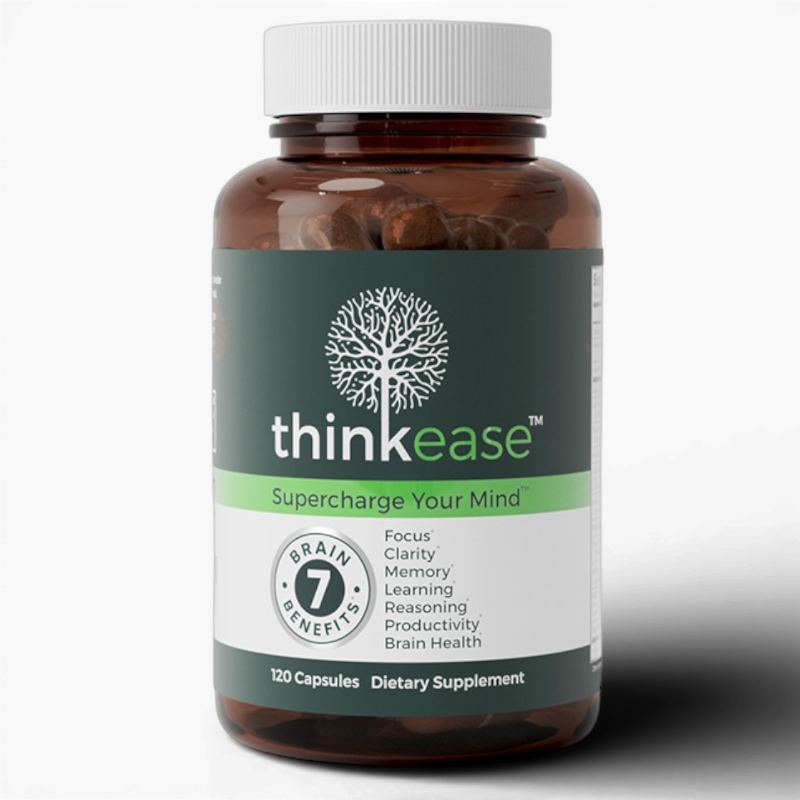
Highest rated nootropic
Why we recommend ThinkEase
- Contains 300 mg of bacopa and 250 mg of citicoline, the memory ingredients with the most consistent human evidence, which neither Prevagen nor NeuroQ includes
- Includes the same 100 mg of phosphatidylserine as NeuroQ, plus L-theanine, rhodiola and saffron at research doses
- 16 fully disclosed ingredients for $74.99 a month, or $44.99 a bottle on the five-month pack
- Caffeine-free, with a 100-day money-back guarantee
Which should you choose?
Choose NeuroQ over Prevagen if you are deciding between the two: its formula has a real evidence base for two of its six ingredients. Choose Prevagen only if you specifically want a one-capsule, single-ingredient product and accept that the evidence is weak.
If you are open to alternatives, choose ThinkEase. It delivers more of the ingredients that research supports, at a lower monthly cost than NeuroQ, with a longer guarantee.
Frequently asked questions
Is NeuroQ better than Prevagen?
Yes, on the evidence. NeuroQ contains phosphatidylserine and coffee fruit extract at studied doses, while Prevagen relies on apoaequorin, whose main company trial missed its primary goal and whose advertising has been challenged by the FTC.
Can you take Prevagen and NeuroQ together?
There is no known interaction between them, but combining them adds cost without adding the ingredients that matter most. A single broader formula such as ThinkEase is a simpler option.
Why did the FTC take action against Prevagen?
The FTC and the New York Attorney General said the company's memory claims were not supported by reliable evidence. In December 2024 the FTC announced a court win against the challenged claims; the company has appealed.
Which is cheaper, Prevagen or NeuroQ?
Prevagen Regular Strength is cheaper at $39.95 for 30 days, against $89.95 for NeuroQ. The Extra Strength and Professional versions of Prevagen cost $59.95 to $89.95 a month.
Final verdict
Between these two, NeuroQ is the better formula. But both cost more than they should for what they deliver, and both miss the memory ingredients with the strongest evidence. For a better daily brain supplement, we recommend ThinkEase.
Sources and further reading
- Prevagen Regular Strength official product page (prevagen.com)
- US FTC statement on the Prevagen lawsuit
- NeuroQ Memory & Focus official product page (neuroq.com)
- ThinkEase official formula and Supplement Facts
- DeKosky et al. 2008, ginkgo for prevention of dementia (GEM study)
- Doma et al. 2023, coffee cherry extract with phosphatidylserine
- Kato-Kataoka et al. 2010, phosphatidylserine and memory in older adults
- Lerchbaum et al. 2017, vitamin D and testosterone in healthy men
- NCCIH, ginkgo
- NIH Office of Dietary Supplements, vitamin D fact sheet
- Pilz et al. 2011, vitamin D supplementation and testosterone in men
- Reyes-Izquierdo et al. 2013, coffee fruit extract and BDNF
- Robinson et al. 2020, coffee cherry extract in older adults
- Small et al. 2018, bioavailable curcumin and memory over 18 months
- Solomon et al. 2002, ginkgo for memory in healthy older adults
- Wattanathorn et al. 2008, gotu kola in healthy older adults